
Google Business Profile optimisation is the process of completing, structuring, and actively managing your GBP listing so it ranks in Google’s local pack and Maps results. In London, where 32 boroughs each run as separate local algorithms, a properly optimised profile decides whether you appear in the top three or nowhere at all.
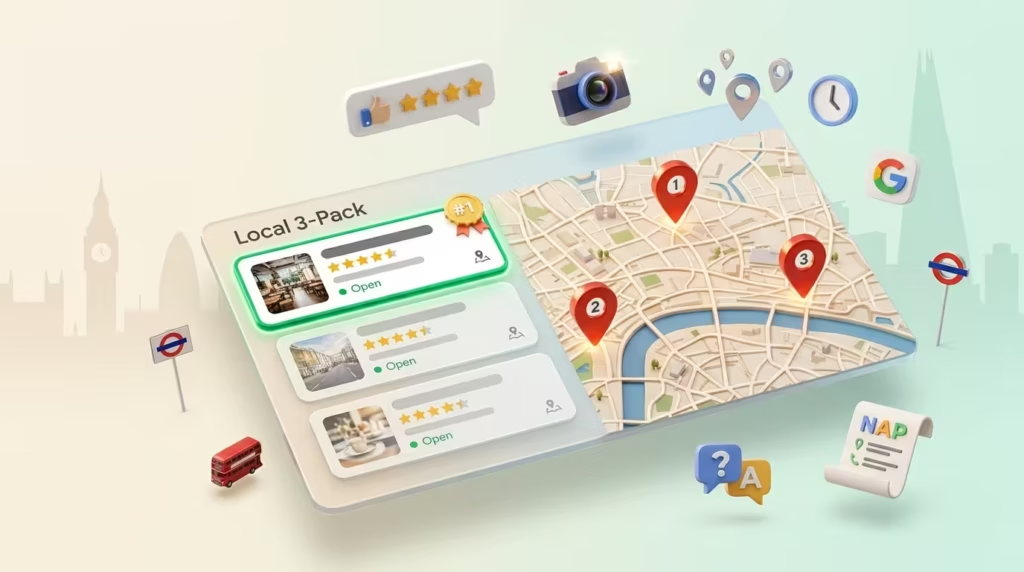

Why London GBP Optimisation Is Different From the Rest of the UK
London GBP optimisation requires borough-level precision because the capital spans 32 separate micro-markets, each with its own competitive set. Most GBP guides treat local SEO as a single problem. London is a different problem entirely.
A user searching “accountant near me” in Bermondsey sees a completely different local pack from someone making the same search in Ealing. Proximity carries significant weight in Google’s local algorithm, but proximity alone does not win. A business in Walthamstow with 400 reviews, detailed service descriptions, and weekly Google Posts will regularly outrank a closer competitor whose profile is half-complete.
This is the core of GBP optimisation UK work in London: closing the gap between where you are and where your customers are searching by making your profile the most relevant, most trusted result Google can show.
London businesses across competitive sectors, including restaurants in Shoreditch, dental practices in Islington, and law firms in Holborn, consistently win local pack positions by out-optimising competitors who rely on proximity alone. An on-page SEO services programme running in parallel with GBP work creates reinforcing signals: when your website and your profile describe the same services, areas, and entities, local pack authority compounds faster.
Categories: The Highest-Impact GBP Signal Most London Businesses Get Wrong
Your primary GBP category is the single most important ranking factor in your control. It tells Google what your business fundamentally is, and it directly determines which search queries your profile is eligible to appear for.
The most common mistake is choosing a broad category when a specific one exists. A dentist in Crouch End should not select “Health” or even “Medical Clinic.” The correct primary category is “Dentist.” A property management company in Canary Wharf should not use “Real Estate Agency” if “Property Management Company” exists, and it does.
Secondary categories extend your eligibility to adjacent searches. A restaurant in Bermondsey that offers private dining should carry both “Restaurant” and “Event Venue.” A gym in Brixton that runs personal training sessions should add “Personal Trainer” as a secondary alongside its primary gym category.
According to Google’s official Business Profile guidelines, categories must describe what your business is, not what it does. That distinction prevents the common error of stacking service-based categories too broad to trigger targeted queries. Review your category list every quarter, because Google occasionally publishes new, more specific options that can shift your ranking within 30 days.


Reviews: Volume, Recency, and Response Rate in London’s Local Pack
Review signals influence GBP ranking on three dimensions: volume, recency, and owner response rate. In London’s competitive local pack, all three matter, and most businesses only manage one.
Volume is the most visible metric. A business with 200 reviews ranks above an otherwise identical competitor with 40. But in London specifically, review velocity matters as much as total count. 200 reviews accumulated over 8 years signals less active trust than 80 reviews from the past 12 months.
Recency is why review generation needs to be an ongoing system, not a one-time push. A florist in Notting Hill that generated 60 reviews in its opening year and nothing since is not competing effectively against a newer competitor with 25 reviews from the past 90 days. Three to five new reviews per month maintains the recency signal.
Response rate is where most London business owners leave easy ranking signals unclaimed. Responding to every review signals active profile management to Google. For negative reviews, a composed, professional response demonstrates trustworthiness more effectively than any number of positive ones. A restaurant in Peckham that responds to a 2-star review within 24 hours with a genuine resolution offer performs better in the local algorithm than one that ignores it.
Google My Business London strategy at the review level means building a simple, repeatable system: ask at the point of peak satisfaction, make the review link frictionless, and respond within 48 hours, every time.
Google Posts and Photos: The Active Signals Google Tracks
Google tracks engagement signals on your profile to distinguish active businesses from dormant ones. How often you post, how frequently photos are updated, and whether users interact with your content all feed into Google’s local assessment.
Google Posts function like a social feed attached to your GBP. Businesses that publish two to three posts per week consistently outperform those that post sporadically. For London businesses, posts work best when they reference local context: a law firm in Southwark promoting a free consultation, a gym in Hackney announcing a new class schedule, a coffee shop in Borough Market highlighting a seasonal menu. Local specificity drives clicks, clicks drive engagement signals, and engagement signals reinforce local pack ranking.
Photos carry more algorithmic weight than most businesses realise. Profiles with regularly updated, high-quality photos generate significantly more direction requests and website clicks than those with only the default Street View image. For service-area businesses operating across multiple London boroughs, including electricians, plumbers, and landscapers, geotagged photos taken at job sites across different postcodes create geographic breadth signals that support wider local pack appearances.
Interior shots drive in-person visit intent, team photos build trust before the first contact, and work samples convert browsing intent into enquiry intent. A well-structured photo strategy covers all three.
Borough-Level Tactics: How to Rank on Google Maps Across London
Ranking on Google Maps across multiple London boroughs requires combining GBP configuration with website signals to extend your visible service area beyond your physical location. Proximity is a hard constraint (you cannot move your office) but you can extend reach through strategic optimisation.
Service area settings: If you operate as a service-area business with no storefront, configure your GBP service areas to include the boroughs you actively serve. A plumber based in Lewisham who serves Lewisham, Greenwich, and Bromley should list all three. These settings directly influence which borough-level searches your profile is eligible to appear for.
Location landing pages: Your GBP profile links to your website. If that link points to a generic homepage, you are leaving borough-level signals unrealised. Dedicated landing pages such as “SEO services in Hackney,” “accountant in Islington,” or “dental practice in Crouch End” linked from your GBP profile create a reinforcing loop: the website corroborates the geographic scope of the GBP, and the GBP drives traffic back to location-specific pages.
For restaurants, this matters acutely. Borough-level GBP visibility is the single highest-leverage signal in SEO for restaurants London, because diners rarely travel more than one or two tube stops for a meal and search intent is hyper-local. A trusted London SEO agency will map your GBP strategy to your actual service geography and build the landing-page infrastructure that makes that geography credible to both Google and users.
FAQs
What is Google Business Profile optimisation and why does it matter in London?
Google Business Profile optimisation is the process of fully completing and actively managing your GBP listing. In London, it decides borough-level local pack visibility.
How do I rank in the local pack for a competitive London borough?
Combine accurate categories, a fully complete profile, consistent monthly reviews, and location landing pages reinforcing your service areas. Local backlinks break ties.
How often should I post on Google Business Profile?
Post two to three times per week for competitive London markets. Each post stays active for seven days before archiving, so consistency matters most.
Does my GBP business name affect rankings?
Your business name must match your registered trading name exactly. Adding keywords breaches Google’s guidelines and risks profile suspension.
What is the most important GBP action for a new London business?
Choose the correct primary category first. Category selection determines which searches your profile can appear for, and the wrong choice makes reviews irrelevant.
Book a free, no-obligation consultation with our expert digital marketing team today. We’ll take the time to understand your business goals, assess your current digital presence, and outline a tailored strategy to help you achieve measurable growth.